Overall SDG Alignment Evaluation:
The Bachelor of Business Administration (International Program) at Khon Kaen University is strategically designed to cultivate a new generation of business leaders who are not only proficient in global commerce but are also deeply committed to ethical and sustainable practices. The program's philosophy explicitly aims to produce graduates who are responsible for society and the environment, a vision that directly supports the United Nations Sustainable Development Goals. The curriculum provides a robust framework for understanding and promoting SDG 8 (Decent Work and Economic Growth) through its three specialized majors: Global Business Management, International Marketing, and International Entrepreneurship. These tracks equip students with the skills to foster innovation, support industrial development, and create new ventures, directly contributing to SDG 9 (Industry, Innovation, and Infrastructure). A cornerstone of the program is its emphasis on sustainability and ethics, as evidenced by core courses like Sustainable Business Management and Business Ethics. This focus directly aligns with SDG 12 (Responsible Consumption and Production) by teaching students how to integrate social and environmental considerations into business operations. By extension, this fosters the development of strong, accountable, and transparent institutions, a key target of SDG 16 (Peace, Justice, and Strong Institutions). Furthermore, the program's international scope and courses on cross-cultural management prepare graduates to operate effectively in a globalized world, fostering the international cooperation essential for SDG 17 (Partnerships for the Goals). As a comprehensive higher education program, it is a direct contributor to SDG 4 (Quality Education), developing graduates with the critical thinking, digital literacy, and global perspective needed to drive sustainable development forward.
Bachelor of Business Administration (International Program) of Khon Kaen University (KKU) has transitioned beyond traditional business teaching toward cultivating "Digital Business Leaders for Sustainability" who possess the capability to guide organizations through the storm of Digital Disruption and cope with the Climate Change crisis in the tourism and service industry.
The curriculum uses the philosophies of Outcome-Based Education (OBE) and Global-Local Integration as the core for learning. Students are equipped with a Blueprint for Practical Application through the integration of in-depth knowledge from key courses such as Sustainable Tourism Management (which focuses on creating business models responsible for the world), Information and Communication Technology for the Tourism Business (which promotes the use of digital innovation), Introduction to Tourism Management, Tourist Behavior, and Logistics for Tourism. All of these synthesize the necessary skills for analyzing and solving business problems in a global context.
This practical learning has resulted in the evident outcome of producing graduates capable of expertly designing and presenting business plans driven by sustainability using advanced digital technology. This success leads to the sustainable impact of elevating the regional tourism and service business sector to become a model of the Green & Digital Economy and truly aligns with the important global missions under SDG 8 (Decent Work and Economic Growth), SDG 9 (Industry, Innovation, and Infrastructure), and SDG 17 (Partnerships for the Goals).
Best Practices
Blood2Breath Campaign
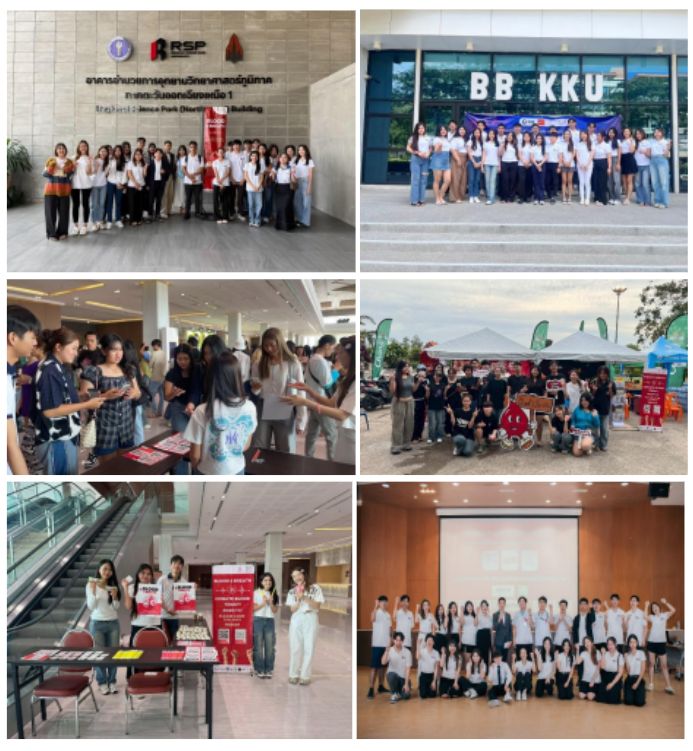
Khon Kaen University, through the International College, has developed innovative teaching and learning that concretely integrates sustainable development into the international business curriculum. In the course IC104761 SEMINAR IN GLOBAL BUSINESS MANAGEMENT, the "Blood2Breath Campaign" (#68-P064) was organized as an activity that combines health service for society through blood donation with environmental conservation through tree planting, under the International College's Sustainable Education Transformation strategy.
This project was designed for students to learn through experiential learning in managing social projects that create impact on both the community and the environment. The campaign was conducted continuously over four sessions from March to April 2025 at diverse locations: Science Park (March 18, 2025), Toyota Kaennakorn Co., Ltd. (March 21, 2025), Faculty of Engineering, Khon Kaen University (March 31, 2025), and Meeting Room M301, Basic Skills Development and Collaborative Learning Building (April 24, 2025). Implementing the project in various locations both inside and outside the university demonstrates the expansion of service outreach to the wider community, especially through engagement with the private sector such as Toyota Kaennakorn, which exemplifies cross-sector collaboration between academia and business for sustainable development.
The tangible outcomes were that students developed project management skills in the global business context, leadership, teamwork, and a sense of corporate social responsibility-all essential competencies for 21st-century business leaders. At the same time, the project generated a positive impact for the community through blood donation drives supporting patients in need at hospitals, and tree planting to increase green spaces and reduce greenhouse gas emissions.
The broader impact was the cultivation of a culture of giving and sharing among students and university staff, the promotion of health and environmental awareness in the business community, the development of a model for integrating the Sustainable Development Goals (SDGs) into the international business curriculum, and the creation of partnerships among the university, private sector, and local communities to drive integrated sustainable development.
This project is clearly and strongly aligned with three core SDGs. It supports SDG 3: Good Health and Well-being directly through blood donation activities that strengthen the public health system and save lives, as well as promoting health and well-being, consistent with the "Health service outreach" and "Health promotion activities" indicators in THE Impact Rankings, which emphasize community health services and the promotion of healthy behaviors. It advances SDG 13: Climate Action through tree planting activities that absorb carbon dioxide, increase green areas, and mitigate the impacts of climate change, in line with the "Low carbon university" and "Education for climate action" indicators, which focus on reducing greenhouse gas emission and providing education on climate change. It also supports SDG 17: Partnerships for the Goals by building partnerships among Khon Kaen University, the private sector (Toyota Kaennakorn), public health agencies, and local communities to implement projects with multi-dimensional sustainable development impact, consistent with the "Relationships to support the goals" and "Cross-sector collaboration" indicators that emphasize cross-sector partnerships to achieve the SDGs.
Additionally, the project supports four key faculty-level indicators of the International College: IC68-03 (number of projects supporting student learning experiences in sustainability/SDGs), IC68-04 (average course evaluation scores), IC68-05 (percentage of accredited programs with good or higher results), and IC68-18 (satisfaction assessment).
The Blood2Breath Campaign is therefore an outstanding example of integrating global business management education with sustainable social and environmental impact, reflecting Khon Kaen University's commitment to producing graduates with both academic excellence and a strong sense of social responsibility, and to build cross-sector partnerships for sustainable development at both local and global levels.
 SDG 1: No Poverty
Alignment Summary: The program addresses poverty reduction through the lens of social entrepreneurship and sustainable business. By teaching students how to create ventures that tackle social problems, the curriculum directly contributes to creating economic opportunities and innovative solutions aimed at ending poverty.
| Course Code | Course Title | Alignment Rationale |
|---|---|---|
| IC 123 010 | Social Entrepreneurship and Innovation | Focuses on creating ventures that address social problems, directly contributing to poverty reduction and promoting inclusive economic growth (Targets 1.1 & 1.4). |
 SDG 4: Quality Education
Alignment Summary: As a comprehensive bachelor's degree, this program epitomizes quality tertiary education. It is designed to equip students with the necessary knowledge and skills for the modern global economy, including specialized training in business, critical thinking, and digital literacy, ensuring they are prepared for decent work and lifelong learning.
| Course Code | Course Title | Alignment Rationale |
|---|---|---|
| IC 102 009 | Introduction to Business Research | Develops essential technical and vocational skills in research and analysis, preparing students for skilled employment (Target 4.4). |
| IC 104 796 | Internship in Global Business Management | Provides significant practical experience in a professional environment, bridging the gap between education and employment and promoting lifelong learning opportunities (Target 4.3 & 4.4). |
 SDG 8: Decent Work and Economic Growth
Alignment Summary: The entire program is oriented towards fostering decent work and sustainable economic growth. Through its majors in Global Business, International Marketing, and International Entrepreneurship, the curriculum prepares students to create and manage enterprises, drive economic productivity, and promote job creation in the global economy.
| Course Code | Course Title | Alignment Rationale |
|---|---|---|
| IC 122 001 | Introduction to Entrepreneurship | Promotes entrepreneurship, which is critical for job creation, creativity, and innovation, directly supporting development-oriented policies (Target 8.3). |
| IC 103 010 | Sustainable Business Management | Teaches principles of economic, social, and environmental sustainability in business, contributing to sustained and inclusive economic growth (Target 8.4). |
| IC 104 785 | Cooperative Education in Global Business Management | Provides students with mandatory work placements, ensuring they gain valuable experience for future employment and contributing to reducing youth unemployment (Target 8.6). |
 SDG 9: Industry, Innovation and Infrastructure
Alignment Summary: The curriculum fosters innovation and entrepreneurship, which are the cornerstones of a dynamic and sustainable industrial sector. Courses on technology management, new venture creation, and sustainable business practices equip students with the skills to build resilient infrastructure and promote inclusive and sustainable industrialization.
| Course Code | Course Title | Alignment Rationale |
|---|---|---|
| IC 123 007 | Technology and Innovation Management | Directly enhances scientific research and technological capabilities by teaching students how to manage innovation within industries (Target 9.5). |
| IC 123 001 | New Venture Creation | Supports small-scale industrial enterprises and entrepreneurship, which are vital for fostering innovation and economic growth (Target 9.3). |
| IC 103 002 | Operation Management | Teaches principles of efficient and sustainable production processes, contributing to upgrading industrial infrastructure and promoting clean technologies (Target 9.4). |
 SDG 10: Reduced Inequalities
Alignment Summary: The program promotes the reduction of inequalities by emphasizing ethical business practices, cultural diversity, and social entrepreneurship. Students learn to manage and work within diverse teams and are encouraged to create business models that address social needs and promote inclusion.
| Course Code | Course Title | Alignment Rationale |
|---|---|---|
| IC 103 009 | Cross Cultural Management | Fosters understanding and respect for cultural diversity, which is essential for promoting the social and economic inclusion of all people (Target 10.2). |
| IC 123 010 | Social Entrepreneurship and Innovation | Empowers students to create enterprises that directly address inequalities by providing services and opportunities to underserved communities (Target 10.2). |
 SDG 12: Responsible Consumption and Production
Alignment Summary: This program places a strong emphasis on responsible production through dedicated courses on sustainable business management and ethics. It prepares future business leaders to implement sustainable practices, manage resources efficiently, and integrate sustainability into their corporate strategies, directly aligning with the goal of ensuring sustainable consumption and production patterns.
| Course Code | Course Title | Alignment Rationale |
|---|---|---|
| IC 103 010 | Sustainable Business Management | Directly educates on the principles of social, economic, and environmental sustainability, encouraging companies to adopt sustainable practices and integrate this information into their reporting cycle (Target 12.6). |
| IC 102 010 | Business Ethics | Provides a foundation in ethical conduct, which underpins the social responsibility required for sustainable production and consumption (Target 12.6). |
| IC 113 006 | Logistics and Supply Chain Management | Teaches efficient management of supply chains, which is crucial for reducing resource use and waste generation in the production process (Target 12.5). |
 SDG 16: Peace, Justice and Strong Institutions
Alignment Summary: The curriculum fosters the principles of strong and ethical institutions through courses on business law, ethics, and corporate governance. By educating students on the importance of accountability, transparency, and the rule of law in business, the program helps build a foundation for just, peaceful, and inclusive societies.
| Course Code | Course Title | Alignment Rationale |
|---|---|---|
| IC 102 008 | Business Law | Provides essential knowledge of legal frameworks, promoting the rule of law which is fundamental to building strong institutions (Target 16.3). |
| IC 102 010 | Business Ethics | Directly addresses the need to fight corruption and develop effective, accountable and transparent institutions by instilling ethical principles in future business leaders (Target 16.5 & 16.6). |
 SDG 17: Partnerships for the Goals
Alignment Summary: With its international focus, the program inherently supports the development of global partnerships. Courses in international business, global marketing, and cross-cultural management provide students with the skills and perspective needed to build and maintain multi-stakeholder partnerships for sustainable development.
| Course Code | Course Title | Alignment Rationale |
|---|---|---|
| IC 103 004 | International Business Management | Provides a deep understanding of the global business environment, which is crucial for building the international partnerships needed to achieve the SDGs (Target 17.17). |
| IC 103 007 | International Business Collaboration | Directly teaches the principles and practices of forming international collaborations, enhancing the global partnership for sustainable development (Target 17.16). |